
Start with a goal
Choose the problem you want your next points to solve: unreliable damage, getting hit too often, difficult traversal or running out of a combat resource. Then follow a connected path to a skill that addresses it. Enshrouded's skill tree lets you mix paths; a build name does not lock your character into one class.
Our suggested starting routine is to support the weapon you actually use, add enough survival to finish encounters, then buy utility that helps your current exploration. This is a planning approach, not a universal ranking of mandatory skills. For wand and staff decisions, see the mage guide.
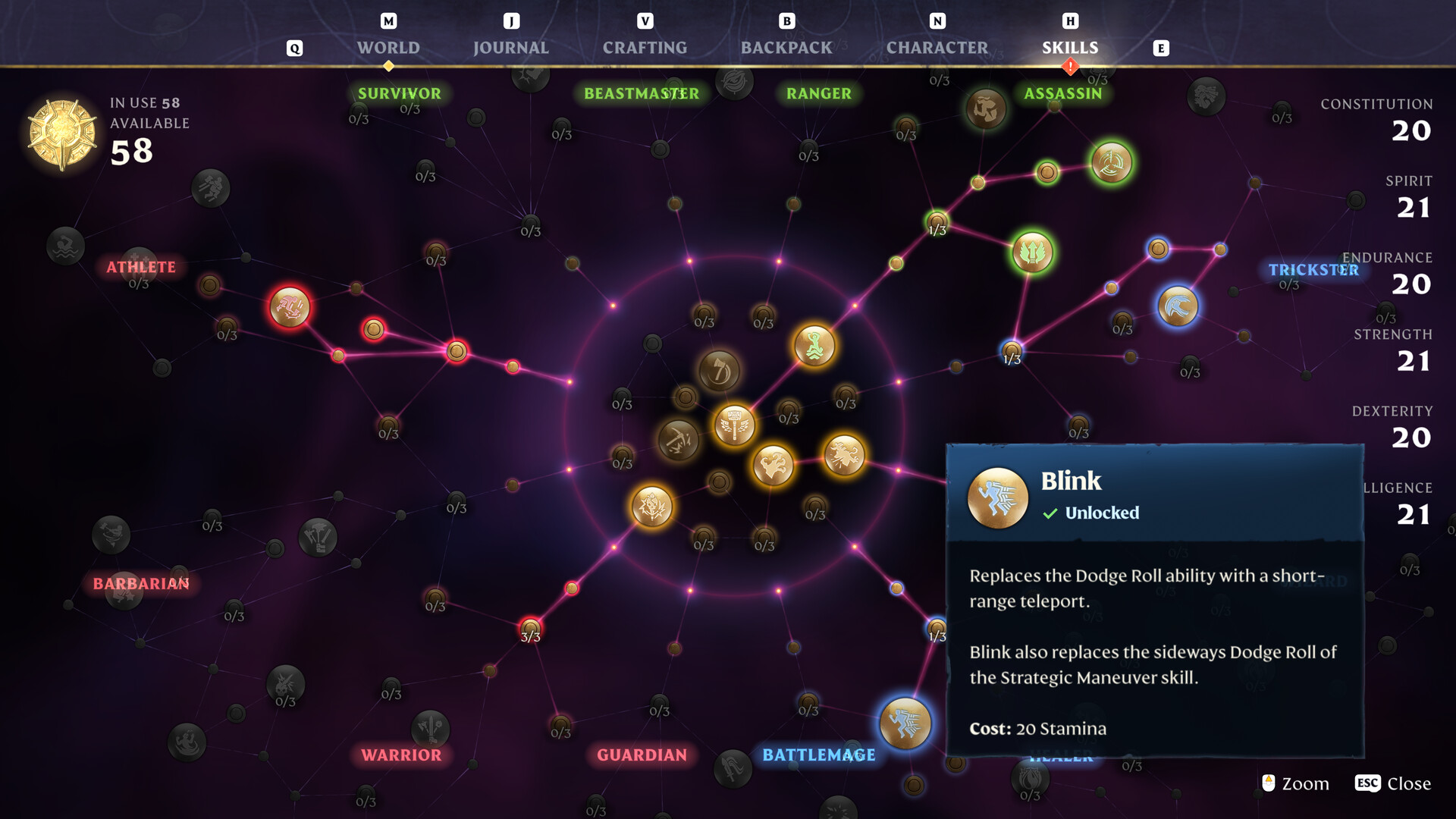
Point budget
Character level and available skill points are different numbers. Leveling gives points, and first completions of Shroud Roots and Elixir Wells add more. Repeating the same completed location does not provide another first-clear point reward for that character.
Count the whole connected path, not just the number printed on the destination skill. Then allow for any additional ranks you intend to buy. An endgame screenshot may assume more exploration rewards than your character has earned, even if you are at a similar level.
The examples below distinguish a node's initial cost from the route needed to reach it. They are not a complete build or a promise that every character should purchase all four.
Useful skills
| Skill | Initial node cost | What it changes | Consider before buying |
|---|---|---|---|
| Double Jump | 2 points | Adds a second jump while airborne. | A simple traversal option; the jump still uses Stamina. |
| Blink | 4 points | Replaces the dodge roll with a short teleport. | Costs Stamina, and reaching it also requires preceding nodes. |
| Updraft | 4 points | Adds lift while gliding. | Check its Mana requirement and your world's charge setting. |
| Water Aura | 1 point for the first rank | Heals you and injured nearby allies, scaling with Intelligence. | Count the connecting nodes; extra ranks affect the aura's reach. |
Movement choices
Double Jump is listed among the current core skills. If an old video tells you to travel deep into a different branch to reach it, check the current tree first. Blink changes your dodge behavior, so try it in a familiar encounter before building your whole defence around it. Updraft serves a different purpose: a gliding adjustment does not replace careful route planning.
Damage and sustain
Read the weapon condition on a talent before purchasing it. A benefit for melee weapons is not automatically a boost to wand attacks or staff spells. Similarly, a healing option can be useful without being the next best investment for your damage.
Water Aura belongs on a magic/healing route, not a generic Tank recommendation. Its Intelligence scaling matters when comparing it with other survival choices. Choose what fixes your actual problem and supports the people you play with.
Plan and test
- Write down your current budget. Use the unspent points and unlocked paths on your character, rather than a maximum-level total from a video.
- Pick one destination. Count each connecting node and the first rank of the skill.
- Read the conditions. Note weapon type, resource costs and any required action.
- Buy a small working path. A functioning attack plus survival is more useful than several unfinished distant branches.
- Try a familiar route or fight. Check whether your original problem improves before adding more ranks.
- Revisit your equipment. Some gear raises skill levels; check the learned-skill requirements rather than assuming an item bonus unlocks a skill on its own.
A talent that changes a spell or summon mechanic also does not automatically grant every spell, item or crafting recipe associated with it. Keep equipment and spell acquisition separate from your point plan.
Reset skills
Use the Flame Altar to reset skill points with Runes. Read the cost shown in your current game before confirming. Runes are also useful for equipment upgrades; plan the change rather than resetting repeatedly without a goal.
Returning to an older character? The official 1.0 changelog says the skill tree resets on the first load of an existing save in that version. Check and spend the refunded points before setting out. A blank tree after that update does not mean you should attempt to farm all your old points again.
Use a planner
The external Enshrouded.tools skill-tree planner can help you inspect a connected path. Its individual skill pages separate the skill's own cost from the cost to reach it. For example, Blink is a four-point node but the displayed starting path totals six.
Compare the plan with your in-game tree and budget. This site provides a written planning guide, not an interactive calculator. We checked the linked skill entries and their displayed costs; planner save/share behavior has not been tested.
Sources
Reviewed October 31, 2026 for Enshrouded 1.0. These priorities are editorial; the site has not tested the build in-game. Costs below refer to the displayed game-data build 25988036, not older video layouts.
- Skills reference: connected paths, point sources and current core-skill placement. Checked through the public search index because direct access was restricted; conflicting old maximum-point totals were not used.
- Individual entries: Double Jump, Blink, Updraft, Water Aura.
- Runes: Flame Altar resets and Rune sources, checked through the public search index.
- Forging the Path update: skill ranks and equipment bonuses, checked through the public search index.
- Official 1.0 changelog: existing-character reset, balance changes and configurable Updraft charges. Recheck older recommendations against the tree in your current version.