
Starting loadout
- Prepare a direct summon you can cast. This supplies an ally before a kill-triggered companion can appear.
- Keep your own magic attack ready. Use a wand and suitable staff spells; the source route emphasizes ice.
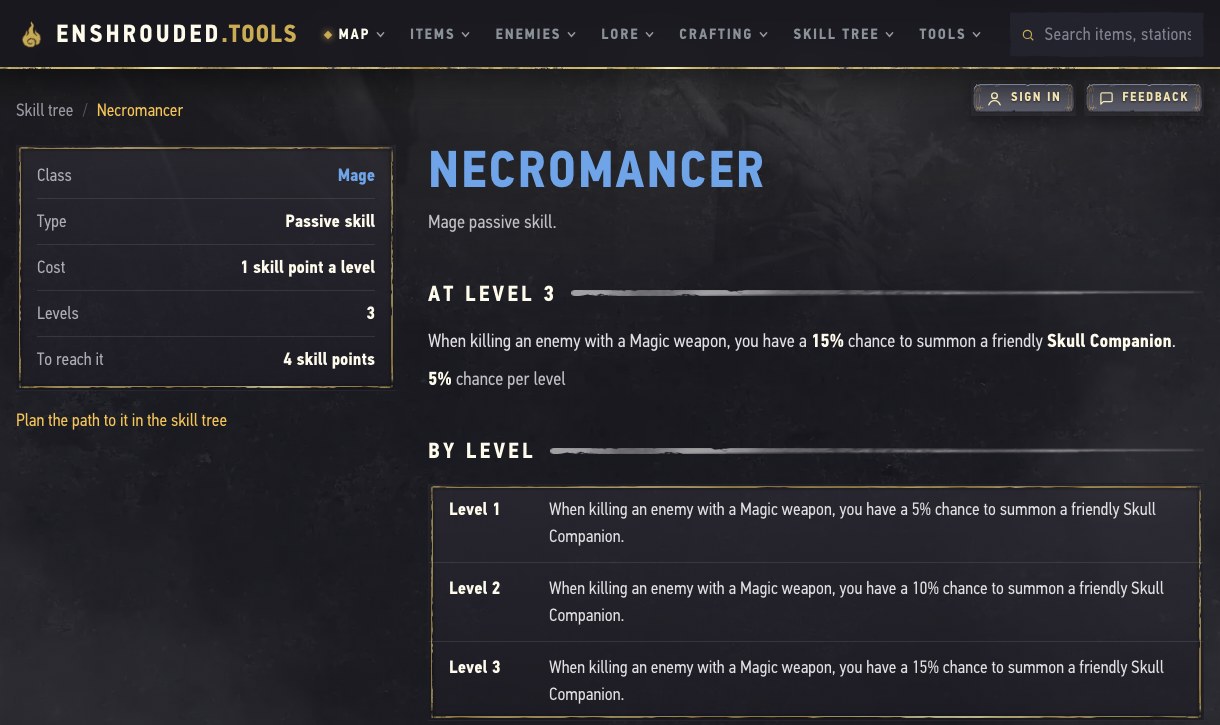
- Read the two effects separately. Advanced Necromancy increases spell-summoned Hollow capacity; Necromancer adds a chance of a companion after magic-weapon kills.
Try one manageable encounter before expanding the build. A companion appearing after a kill does not prove that your direct summon spell is equipped or available.
The build in brief
Combine directly cast Hollow allies with magic-weapon kills, then keep dealing damage yourself. The Necromancer skill is a trigger-based addition to an active caster; it is not a button that guarantees an army before the first enemy dies.
This guide focuses on an ice-and-summons approach. For a setup centred on placing elemental totems, use the summoner guide. Both approaches share magic equipment and parts of the skill tree; the names describe priorities, not separate locked classes.
Put the core together
| Part | What it contributes | Your check |
|---|---|---|
| Direct summon spell | An ally you can cast before combat | Equip a usable summon and check its mana cost |
| Advanced Necromancy | Additional capacity for spell-summoned Hollow allies | Read the current rank and summon limit |
| Necromancer | A chance of a companion after qualifying magic-weapon kills | Check the trigger in the skill tooltip |
| Wand and staff | Your own sustained attacks and spell casts | Keep a dependable attack available when mana is low |
The source build uses Eternal Hollow Wretch II, an ice wand, Blizzard and Ice Bolt. You can establish the playstyle before obtaining every named endgame item. A different spell rank or wand may be appropriate to your current progression.
Spend points with a purpose
Prioritize Intelligence, then enough mana support and survivability to sustain your actual encounters. Trace the connecting nodes in your own skill tree before spending; a list of skill names is not the full path cost.
For the ice approach, the source combines Mage Apprentice, Iceman and Wizard with movement and resource support. Add Blink or other useful movement when getting trapped is what ends your fights. Add recovery when you repeatedly run out of mana. Avoid copying displayed bonus ranks from equipment as if they were all purchased skill points.
Choose useful equipment
Staff of the Moor is a source-build example for Necromancer bonuses. Stellar Wand is its ice-wand example, and Gem of Greater Necromancy adds another kill-triggered ally. Read your item's unlocked upgrades before treating a named drop as an improvement.
Look for relevant magic damage, mana recovery, health and protective bonuses across your armour and accessories. Replace one weak piece at a time. The mage guide explains the underlying wand-and-staff loop without requiring this entire summoning loadout.
A practical combat loop
- Cast your direct summons before engaging, within your current limit.
- Let enemies commit while you choose a position with room to move.
- Use wand attacks between staff casts; keep contributing damage rather than waiting for companions to finish everything.
- Use an area spell when enemies group together, then reposition.
- Replace lost allies and recover resources when safe.
Success check: you can begin an encounter with a usable ally and maintain your own attacks. If companions only appear after kills, that is the trigger-based effect; test your direct summon separately. An isolated boss gives fewer kill opportunities than a crowd, so plan around movement and casting rather than assuming the same summon uptime.
Sources and version
Reviewed November 1, 2026, using published 1.0 build material. This is a progression-oriented adaptation, not an in-game benchmark or a claim of best-in-slot damage. Trigger percentages and complete rank budgets are intentionally left to the current tooltips rather than mixing conflicting source ranks.